Pegasi (singular pegasus) are an equine species found in The Crater. They are medium-sized omnivores that can fly and share a lot of similarities with birds, despite not being related to them.
Most pegasi in the Crater live in the Nest.
Description
_____________________________
Pegasi come in various sizes, some tiny and some bigger, but they are still quite small compared to the other equine species. They have strongly-built bodies, with large wings composed of three segments. Their whole body is covered with feathers (no fur), which also covers their hooves. Their snouts are beak-like, and their ears are very movable small wings. Eyes are all black, except for the pupils which are usually of a striking color. Their head-crests and tails are exclusively made of feathers, coming in various shapes among individuals.
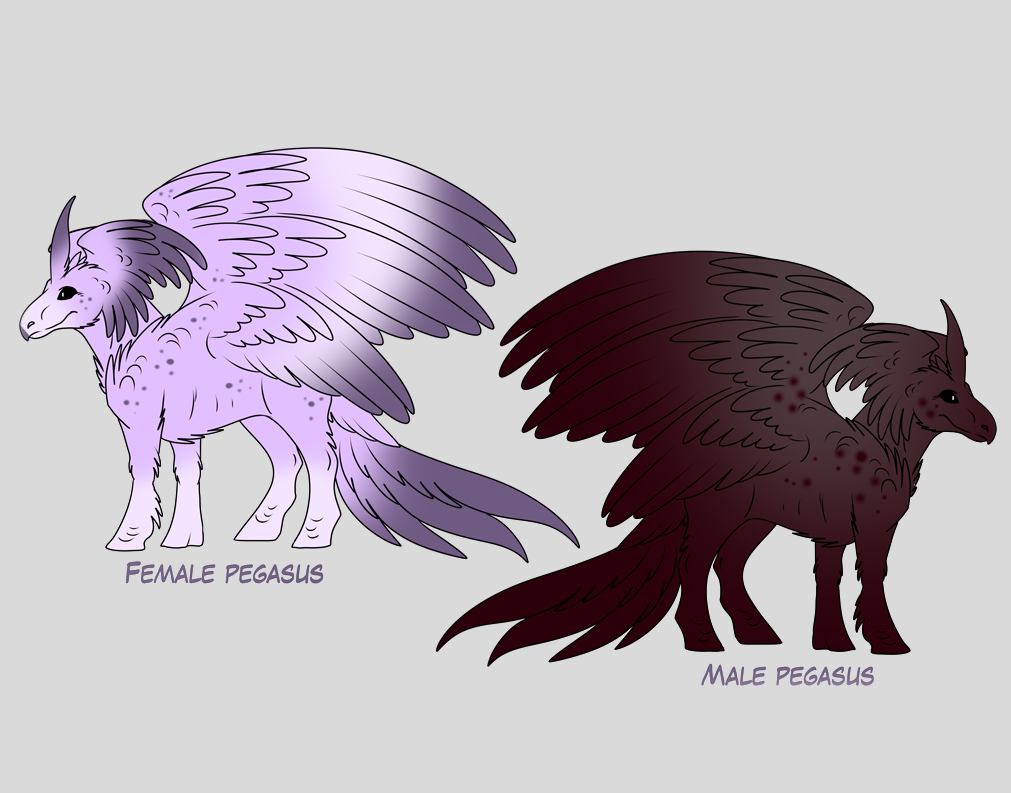
a female pegasus has a lighter main color, while a male pegasus has a darker main color. (click to zoom)
It has been stated that males have darker colored coats, while females have lighter main colors. Pegasi have a large diversity of coat colors and patterns. Despite their gender coded coats, they have ways to change their coloring to their liking, by using dye made of plants. The dye can be partial or complete, and will last some weeks before fading.
Pegasus(equus pegasus)
Also called
Bird horses
Average size
variable (1.5m ~ 2m)
Lifespan
~130y
Diet
Omnivorous
Environment
variable (cold biomes prefered)
Status
Vulnerable
Known characters from this species
Known hybrids characters
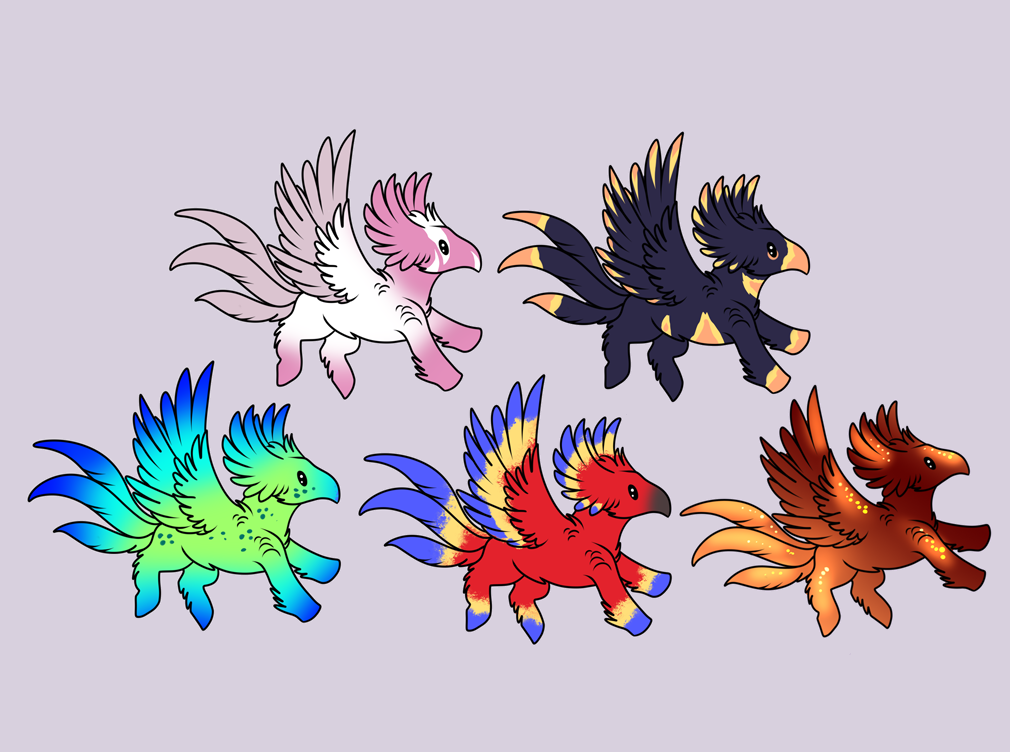
Examples of acceptable coat colors for pegasi. (click to zoom)
Any colors are okay for pegasus, dule or bright colors, any kind of markings, as long as it respects the gender coding.
Despite being equines, pegasi resemble birds in behavior. They produce a large variety of sounds, and are very chatty creatures. Highly social, they developed
a way of communicating through long distances - whistling. The whistling language can only be produced by pegasi (and noctules who learned it from them), but can
be understood by other species if they were exposed to it enough (though they will not be able to produce it).
Pegasi are quite skittish and naturally avoid confrontation, prefering to take flight when they feel threatened - it is not their first instinct to fight, but the
latest events in the Crater and the sudden disparition of the unicorns made them considerably more aggressive towards their predators (kelpies and noctules). They
are curious creatures, and will often investigate anything new they encounter - pegasi are known to be very thirsty for knowledge that can lead them to new
discoveries.
Sentinel pegasus whistling to alert clanmates.
The bird horses are mostly nocturnal creatures, and will therefore be more active at night and at the twilight hours. They can see very well in the dark, and their black sclera helps a lot with the strong lights that can occur in the clouds or snow, but their sense of smell is not
the best. Being very good at flying thanks to their three-segmented wings and their light weight for such big creatures, their agility is remarkable and makes them efficient predators to small prey (rabbits, birds, rodents...).
They are attracted to the stormy skies, and will often be seen flying during thunderstorms, "playing" with the lightning and strong winds. Pegasi are able to know
where the lightning is about to strike some seconds before it does, an ability that is very useful in their prefered environment, the snowy mountains.
Body language is an important part of their communication, as they can express a lot of emotions through their wings, tails and head crests. Their head wings
are very sensitive, providing them very effificent hearing. Omnivorous, these equines will eat a lot of different things, from plants to small animals,
including fruits, seeds, roots, insects. Pegasi are very careful of their plumage, and will spend a lot of time cleaning and oiling their feathers to keep
their abilities at their best- they naturally produce oil, but can use various products to improve it.
When pegasi reaches maturity (around fifteen years, the equivalent of twenties for humans), they might start looking for a partner (or not... it's a posibility).
Pegasus courtship is similar to birds, expect the male AND the female will perform for eachother, and will both try to impress the other with their flying and more
specifically dancing skills. An interested mate will return the other's advances and gifts, and all of this will eventually lead to a strong bond betwteen the two.
Mother pegasus with her young filly.
Pegasi couple will usually have one foal at a time- as they are equines, foals are born the same way as horses, and DO NOT hatch from eggs. Newborn foals
are very small and fragile, covered in down and unable to stand up.
They will be kept in a nest made of feathers and other soft materials, and will require the mother's
milk to survive, but will be introduced to solid food very quickly after their birth. The whole clan takes care of the foals, males and females alike, especially
the nurses who work full time to take care of the newborns in the nursery, ensuring the temperature is right and all the foals are fed and healthy. This way, parents
can take care of themselves and keep serving the clan. When a foal is ready to walk, the nurses will keep teaching them the basics,
and will join their parents' nests and leave the nursery.
Newborn pegasus (Oro) in the nursery.
Sadly, it can happen that a foal is orphan, and when this is the case, the nurses will take care of them until they are adopted by a new couple, or a solo parent. This is very common for them to adopt orphan foals.
Young pegasi will experience a complete molt around the age of 1-2 years, and will lose all their down to grow their adult feathers. This phenomenon can reveal new
colors and patterns, which can be drastically different from the foal's original appearance. The molt will be repeated every year, but will be less drastic and almost
unnoticeable as only the damaged feathers will be replaced.
After the first molt is completed, the foal will naturally start to jump and use their wings. With the help of their parents, they will eventually learn to fly, and
will have to practice to be able to pass the "first dive", a flight evaluation that will permit them to access school and higher lessons. A pegasus is considered adult
at the age of fifteen years.
Pegasi are social creatures, and have a hierarchy as well as a ranking system that they shared with unicorns. Each member of the clan is important and pegasi
are devoted to their community.
Viceroy (masc) Vicereine (fem)
The Viceroy is believed to be the mortal form of her Majesty of the Night (the moon), hence the term "viceroy" instead of king or queen,
as the Moon is the true sovereign of all clans. A Viceroy's role is to make the important decisions for the clan. All the clans were
under the authority of the same viceroy, who was visiting each one of them.
Enchanter (masc) Enchantress (fem)
All clans have the same viceroy, but each
clan has its own enchanter. Second most
important role in the hierarchy, the
Enchanters govern and make the
decisions for their clan when the Viceroy
is absent. They all wear their unique
ritual cloak. They are blessed with the
ability to hear the Moon's will, and
suggest the Viceroy in their decisions.
Soldier
As their name suggests, the soldiers defend the clan
from any danger. Most of the unicorns end up as
soldiers, while very few pegasi accessed this rank in
the past. Now that there is no more unicorns,
soldier pegasi are way more numerous.
They all obey the Viceroy's will, however, all
groups of soldiers are led by the oldest member.
Soldiers guard the nests, but also the territory,
and other things that require a bit of... strength.
Great Healer
There's one to ten healers per clan,
depending on the number of members.
Their role is to cure the diseases and
injuries of their clanmates. Most of the
time, this role is occupied by pegasi,
though unicorns can rarely access that
rank. Great Healers have a lot of
knowledge of plants and anything that
can be used to heal their peers.
Artist
Sculptors, painters, cartographers... Artists are very important members of the clan,
as their role is to consign the stories and science
of pegasi/unicornkind. As they do not use
any written records, all the stories, important
events, and studies are immortalized in
sculptures, paintings, and more.
The cartographers are very important
for the whole clan to get to
know their environment better.
Forager/Hunter
They feed the clan. As pegasi eat plants,
seeds, fruits and small prey, foragers
have to gather these ressources and bring
them back to the nest. Setting traps and
lifting heavy baskets are their daily missions.
They do work closely with the cartographers
to mark the food sources on the map.
Nurse
While all parents care for the foals in the nursery, some
pegasi and unicorns work daily to keep the babies in good
health while parents are busy. Keeping the babies warm,
feeding them, protecting them and keeping an eye
on those who are able to run/fly is a very big
responsibility.
When the foals are big enough, nurses will
also teach them the basics.
Before the unicorn's extinction, there were numerous clans all over the world. Pegasi built their homes in the mountains, to avoid the disturbance
from humans and their natural predators. Today, as the unicorns are extinct and the world is changing to become more and more welcoming to creatures, pegasi gather together
inside the Crater to protect themselves, joining the clan that birthed the latest Vicereine, Heimdall. They know they are stronger when they are united, and being close to
the Vicereine makes them feel safer.
Back then, all clans were named after a celestial object, and the symbol of the clan was worn by the members.
The clan of Heimdall is the Crescent Moon clan, which is why Heimdall has a crescent moon symbol and on armor.
Now that the clans are unified into one, pegasi might still wear the symbols of their former clans as a reminder of their past.
The announcement pedestal is always situated in a place where the Moon is fully visible.
All clans have a main home, the Nest as they call it, which is most of the time located in a high place such as mountains. All Nests are different, but
they contain similar rooms and areas, such as the nursery, the conference room, the infirmary, the announcement pedestal, and pegasi personal homes.
Pegasi doing activities in the Nest.
Pegasi's Nests are very well organized, every single member of the clan has a role to play and makes sure everything is well kept. The higher ranks don't even have to
give the orders to forage, as the lower ranks know what to do and will do it without receiving orders. Their community instinct is very strong and a pegasus need to feel
important to the clan. If one individual has a problem, the others will naturally help with it.
Pegasi have their personal homes in the Nest where they can rest and stock their personal belongings. Usually these homes are built in the walls of the mountains. The higher
ranks have bigger appartments inside the mountains, usually quite close to the conference room. At the time of the separated clans, the Viceroy had a place to stay in each
Nest, even if he was not there most of the time, it was an important thing to keep the room ready for their visit.
Heimdall visiting her father's grave at the cemetary.
All Nests have a cemetary near - still located very high to avoid scavengers, as pegasi don't bury their dead. The reason behind this is because of the Moon - when a pegasus
or a unicorn dies, it is believed that the Moon will welcome their souls, therefore hiding a body under the ground would be hiding them to the eyes of her Majesty of the Night.
Cemetaries are mostly gravestones (without writtings on it, as pegasi do not have a written langage), with skulls and decaying bodies facing the skies.
The dead ones' relatives will often visit them, bringing flowers and pretty things to them to honor their memory.
In death, all pegasi and unicorns are the same, regardless the rank they had during their lives - even the higher ranks are buried like the other members of the clans. Once
one individual dies, it is believed the Moon will grant them a new existence in the clan. It is no secret that the cemetary of the Nest has a lot of unicorns as of their
recent extinction, but many unicorn remains are still visible all over the world and the Crater...
Representation of an hypothetic Viceroy/Vicereine.
Pegasi and unicorns have a strong connection with the Moon - to them, the Moon is some sort of deity that have great influence over their lives and their way of thinking their world.
Whether this is true or not is unknown, but most pegasi believe in the what they call "her Majesty of the Night".
The Viceroy is the incarnation and living representative of the Moon, which is why they have the highest rank in the pegasi hierarchy - the Moon is considered to be the real
sovereign of pegasi, just above the mortal Viceroy. The Nests are built on mountains to be close to the Moon.
Most of the rituals, ceremonies and clan decisions are made by asking the Moon's will, which is the Enchanters' duty. Pegasi will often pray to the celestial body, and
thanking it for the good things that are happening to them or the clan. The Moon is also one of the reason pegasi and unicorns are more active at night.
Unicorn and pegasus together.
Pegasi and unicorns were known to live together, in a symbiotic relationship. Both species found advantages by staying which each other - this ancient relationship
led to a very strong connection between the two species, who were living together for millennia until the dissappearance of unicorns.
Unicorns were very protective of pegasi. Their natural strength and their ability to fight kelpies and noctules were essential to the pegasi' survival. In exchange,
the pegasi offered all their knowledge and comfort to the unicorns.
Heimdall's existence shows that unicorns and pegasi could mix and have offsprings. Hybrids remained rare during their history, but unicorn and pegasus couples were very
common.
Since the unicorn extinction, pegasi are actively carrying the memory of the unicorns through murals and such. But they are never talking about what caused their
extinction. It seems to be something the adult never talks about, so the young pegasi don't even know what happened to them.
Heimdall is still haunted by the memory of the noctule who chased her when she was young.
Pegasi are mistrustful by nature. They are prey to bigger creatures, like noctules and kelpies, and will not stand a chance if caught due to their size and very light bodies.
Pegasi are scared of kelpies and are actively trying to locate kelpies nests in the Crater. They are calling them "water demons", referencing the natural aquatic environment of kelpies, and their dangerous nature. They seem to be very cautious of the adults, but the guards have orders to kill any kelpie foal they could encounter if it's possible.
It is pretty much the same with noctules, and are calling them "shadow demons". Noctules are known to get much closer to pegasi's Nest than other predators. They can
imitate the whistle language perfectly - not to mention pegasus are very easy prey to them. The cervid creatures are talented to learn pegasi sounds and voices, and are reputed
to try luring the bird horses out of the Nest, which is why there's a lot of pegasus sentinels all around the Nest.
Recently, pegasi have been seen interacting more aggressively with "demons", and have developed special apparel to avoid injuries in fights. It seems they have
decided to fight instead of fleeing. Not all pegasi agree with this thinking - some want to leave the "demons" alone, some think they are equal to pegasi.
Abilities and powers
_____________________________
Sharp beaks : Even without teeth, pegasi can bite hard.
Flight : Pegasi are not only able to fly but are really good at doing acrobatics and complex figures in the sky.
Sharp feathers : some pegasi have very sharp feathers that can cut skin, including sharp quills.
Trivia
_____________________________
▪ The pegasi from Water Demons universe are heavily inspired by the original pegasus myth, but have more bird-like characteristics.
▪ Pegasi are not related to birds despite their similarities. Their ressemblance is the result of convergent evolution.
▪ They cannot be tamed by humans, as they are too easily scared and agitated, and their community instinct is too strong (a pegasus can't be satisfied of the company of a single individual and requires a clan).




.png)
.png)
.png)
