Freshwater kelpies are one of the two species of kelpies that can be found in the Crater, alongside their cousin species, saltwater kelpies.
They are large, striped carnivore equines that live in freshwater.
Description
_____________________________
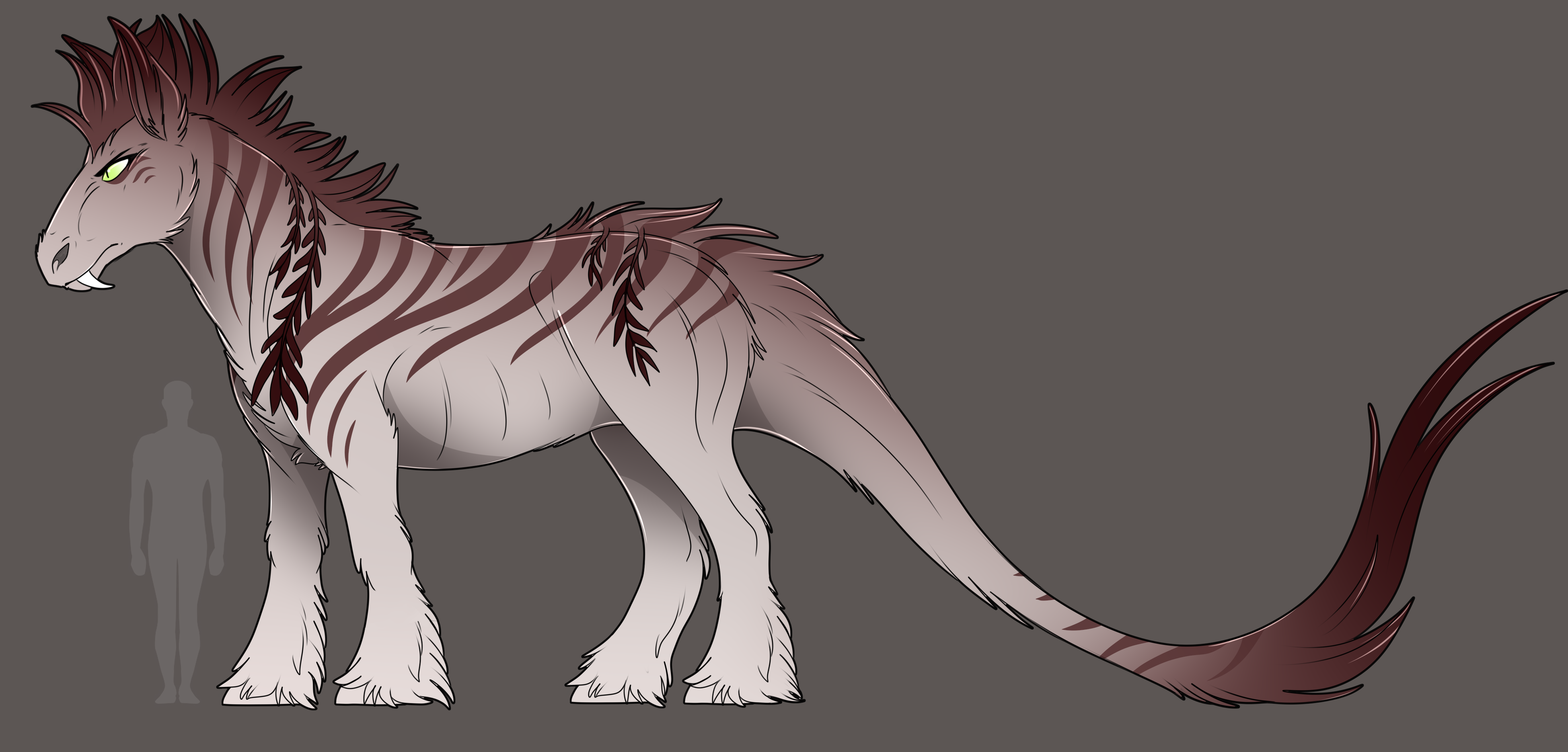
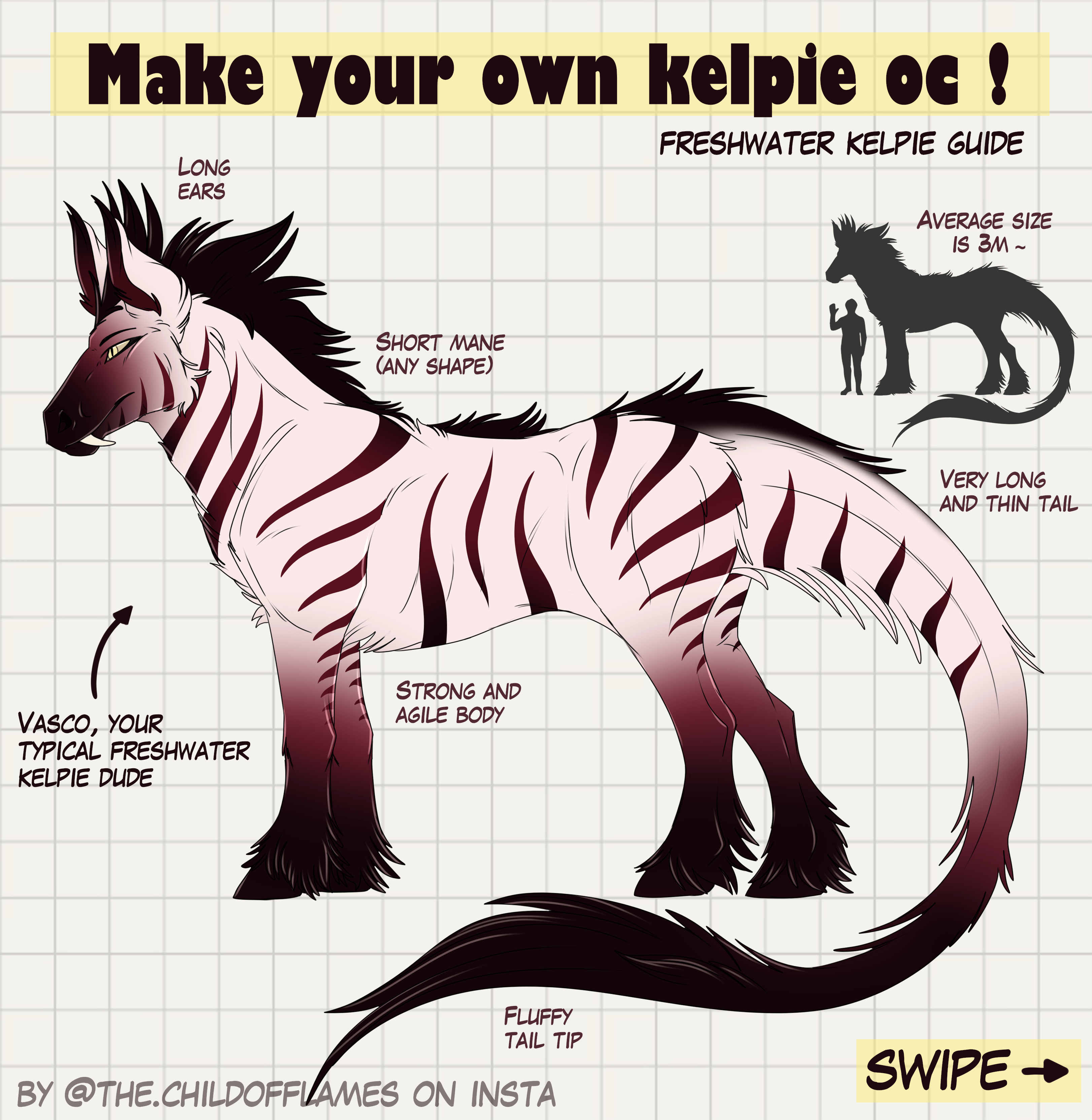
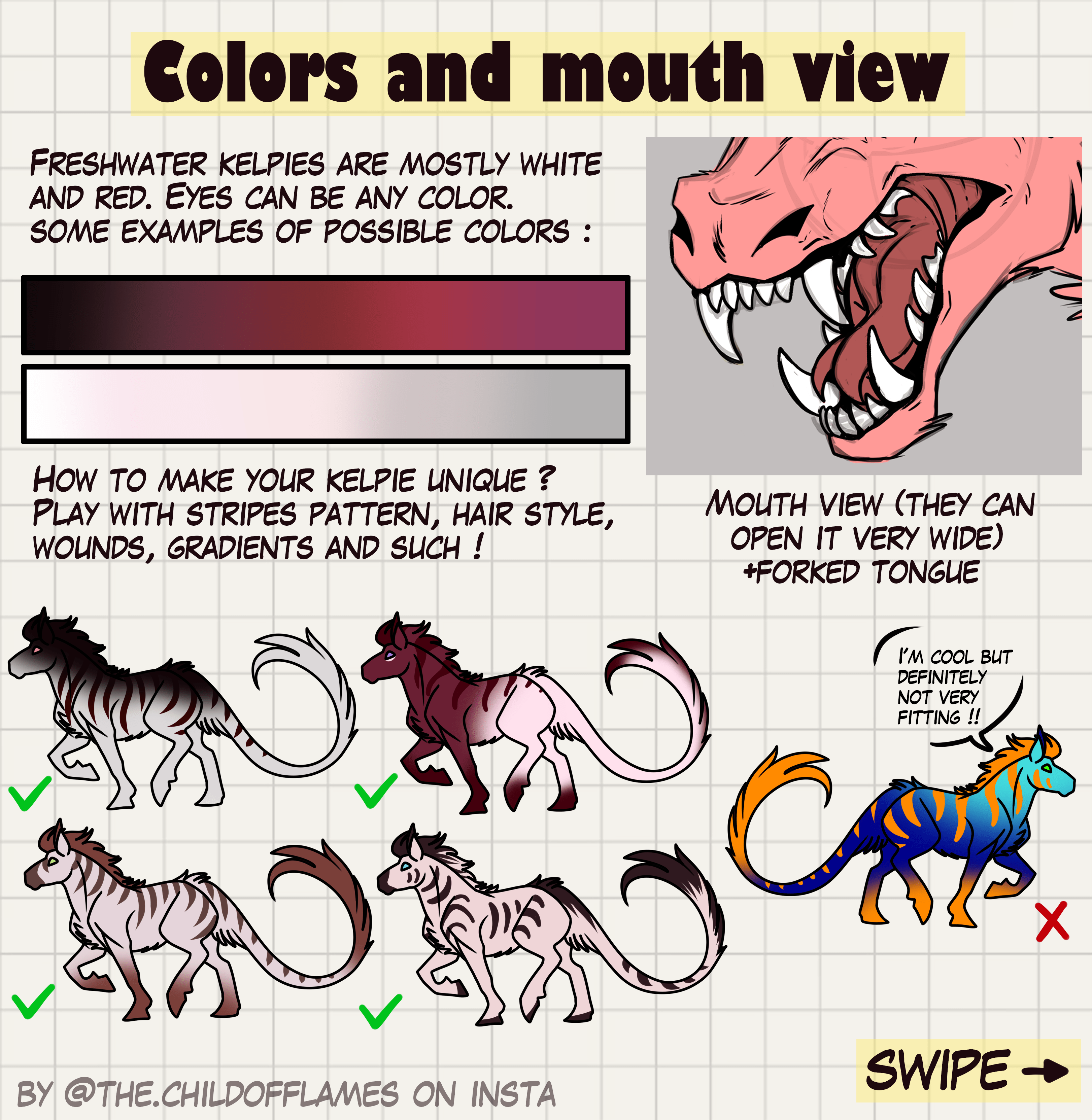
Freshwater kelpies are mostly of white and red shades ; they have medium-sized impermeable fur, ideal for a creature alternating between land and water.
The major characteristic of their coats is their red stripes which can have various shapes and placement over their body. They are mostly strongly built,
similar to draft horses, and despite spending most of their time in the water, they have no problem evolving on land as well, especially when it comes to hunting. There is no visible dimorphism between males and females kelpies.
a freshwater kelpie has a white/grey base color, with red stripes/gradients. (click to zoom)
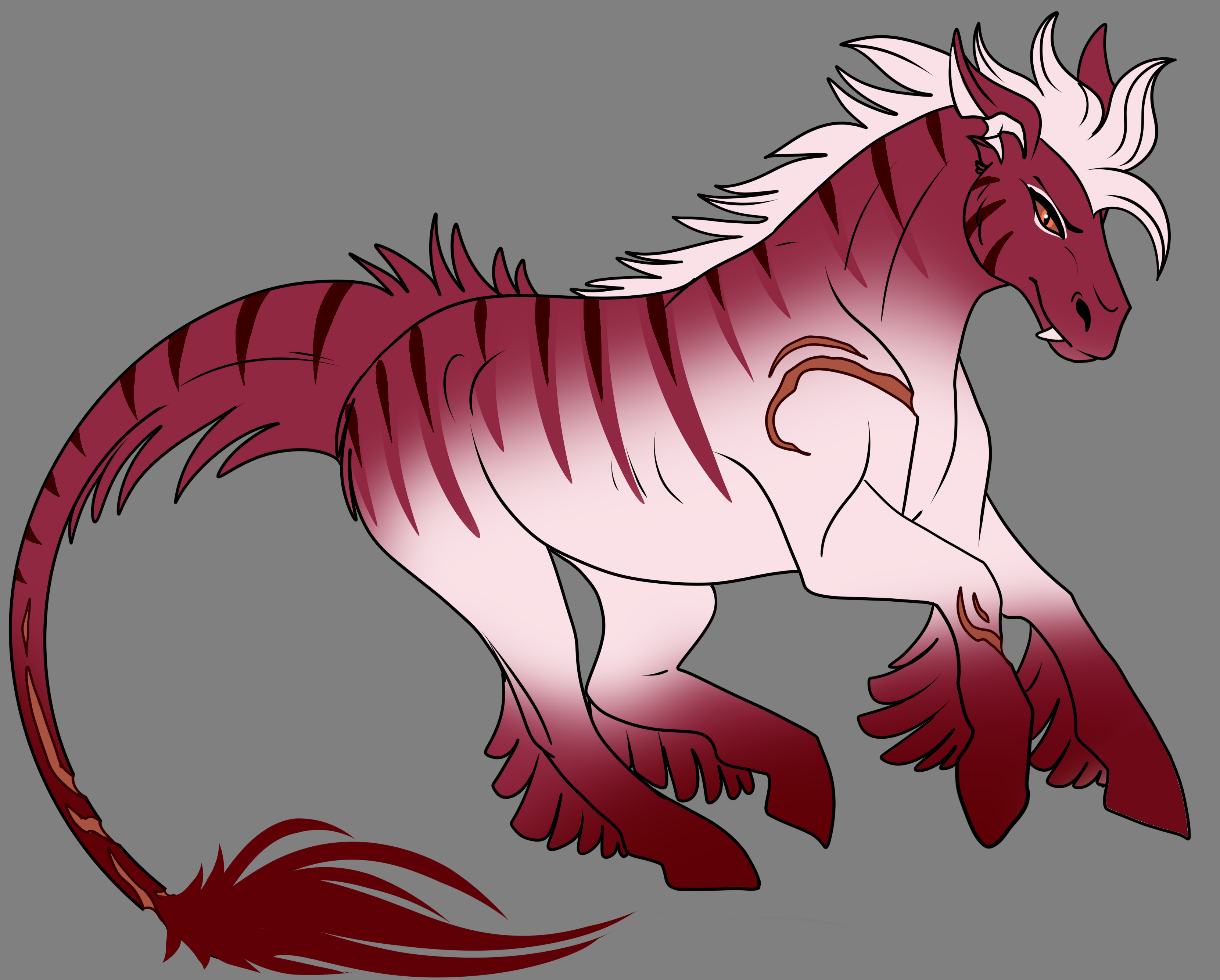
Possible colors of freshwater kelpies. Basically any red hue is acceptable (brown, pink ect...)
They have a forked tongue, that is very coarse. Their eyes react to light similarly to felines, but the pupils also dilate and retract depending on the individual's emotions. The eyes emit a faint glow in the obscurity, and they
do have a nictating membrane to protect their eyes.
Their large saber teeth are always visible, and their powerful jaws can crush bones and flesh without a problem. The tail is very long, contrary to the mane,
and is usually short and straight like zebras. They have more or less kelp visible on their body depending on the individual, as they have the ability to control it.
They are known to be very resistant ; their skin is very thick, and their wounds heal very quickly when the water is pure. Unfortunately, water pollution is what they
fear the most, as they can get sick very quickly and die. The lack of hydration can also be fatal to kelpies- a dehydrated kelpie loses its powers and gets weak very fast.
Freshwater kelpie(equus venator aquadulcis)
Also called
Water demons, freshies
Average size
~3m
Lifespan
~200y
Diet
Strictly carnivore
Environment
lakes, rivers, red kelp forests, forests
Status
Endangered
Known characters from this species
Known hybrids characters
Despite being equines, freshwater kelpies resemble felines in behavior. They can purr, they groom themselves a lot, and they enjoy playing...
They tend to be very aggressive to other big predators (other kelpies, for example) and will chase them off their territory ; they don't necessarily take the risk of killing
opponents unless they feel very threatened. Other than potential competitors, they are not particularly aggressive creatures in general, but the sight of a prey can trigger their hunting instincts, especially
when they are underwater, as it is their natural response to any movement at the surface. It is not rare to be accidentally bitten by a kelpie if you
are not cautious. Best thing is to make some noise at a reasonable distance of the water to make kelpies aware you are not prey.
Depiction of a kelpie in a kelp forest.
Most of the time, freshwater kelpies will be seen chilling in their lakes, rivers or forests. They usually prefer to stay in the kelp forests, where their
stripes camouflage is the most effective. Kelpies feel safer this way, and more relaxed. When they let themselves be seen, they are less likely to attack
as they are not hunting, and don't feel threatened. They are diurnal creatures, and will be active from dawn to dusk, while they will sleep underwater at night.
It doesn't mean they can't be active at night, but it is rare.
Most of their activities outside hunting are related to the water, as their presence
trigger the growth of red kelp forests they like to take care of. They groom themselves a lot, and will also let birds and fish clean their teeth. Kelpies
are usually maniac with their hygiene and the quality of the water, so it's not uncommon to see them get rid of some unwanted elements that could end up
in their habitat.
When kelpies reaches maturity (around fifteen years, the equivalent of twenties for humans), they will either start to wander off their parents' territory naturally, or
they will be chased away by their parents. Females will quickly find a territory to settle down, usually not far from their parents' one, searching for lands with
quality water and prey.
Kelpies stallions will become wanderers, and will start to roam, often entering the territories of other kelpies in the hope to be accepted by a female. If
the mare already has a partner, the stallion will most likely be chased away by the couple to avoid the competition for prey.
Depiction of a kelpie in a kelp forest.
Kelpies are known to mate for life, so if the mare or the stallion dies, the other one will generally stay alone for the rest of their life. It's rare to see them
accept a new partner after the dissapearance of their first mate.
The species suffers from a very slow breeding rate, and it can take years for a couple to have offsprings. They will only breed if they have access to quality
resources (mostly food and water). When the female is expecting, the couple will start building a nest underwater, made of kelp and other plants.
Kelpie foals are born blind and deaf.
Kelpie foals are born with eyes and ears closed, are not able to stand up like most equines, so they are very vulnerable. They entirely count on their parents to
survive the first years of their life, and the mare will mostly stay in the nest as she is the one to feed the foal, but the male will also stay with the newborn
to keep it warm when the female is gone. Kelpies become more aggressive when they have a foal.
After a few weeks, the foal can swim and discover the lake, but
can't breathe the surface's air yet. It takes some months for a foal to be ready to go outside the water, and it is the most dangerous moment of their lives as they
are usually very curious and develop their hunting instincts. This is why the parents need to be very attentive as a foal can quickly wander too far and can suffer
predation from other creatures.
Foals will grow baby teeth around three month old, and will gain their definitive stronger teeth around five years.
Lewis returning with a doe he killed.
Most kelpies will ignore smaller creatures on their territory and will not bother to hunt, as long as they are no threat. Even if
they can eat any other creatures, kelpies will prefer bigger prey to not waste their energy. They are mostly looking for deer-sized prey, and even if they live in
the water, they do not eat fish. Most of them avoid attacking other talking creatures, as they respect their conciousness, or because they are scared of eventual
retaliation, but some kelpies just doesn't care about this and would eat anything.
Kelpies will always hunt during daytime, to avoid conflict with noctules. Their red stripes offer them the ability to blend perfectly in the red kelp forests ;
this way, they can ambush prey who would come drinking/swimming in the lake without being noticed too early.
If no prey is coming, kelpies will not let themselves
starve and will go off the water, usually to find another pond or river so they can reiterate their ambush method. They can hide in the forest's vegetation as well,
but it is rarer as they prefer to attack directly from the water.
They use their powerful jaws to break their prey's neck, but will also use their kelp vines to prevent the animal
from hurting or escaping them. Kelpies like to do the work as quickly as possible to return hiding in their lake without being noticed by their freshly killed prey.
If they can't drag the prey to the water, they will eat it on land and leave the rest to the scavengers. Kelpies will only eat what they killed themselves, or
what a parent/partner killed. They will only eat from carrions if they are starving, which is common for wandering stallions who have no other choice.
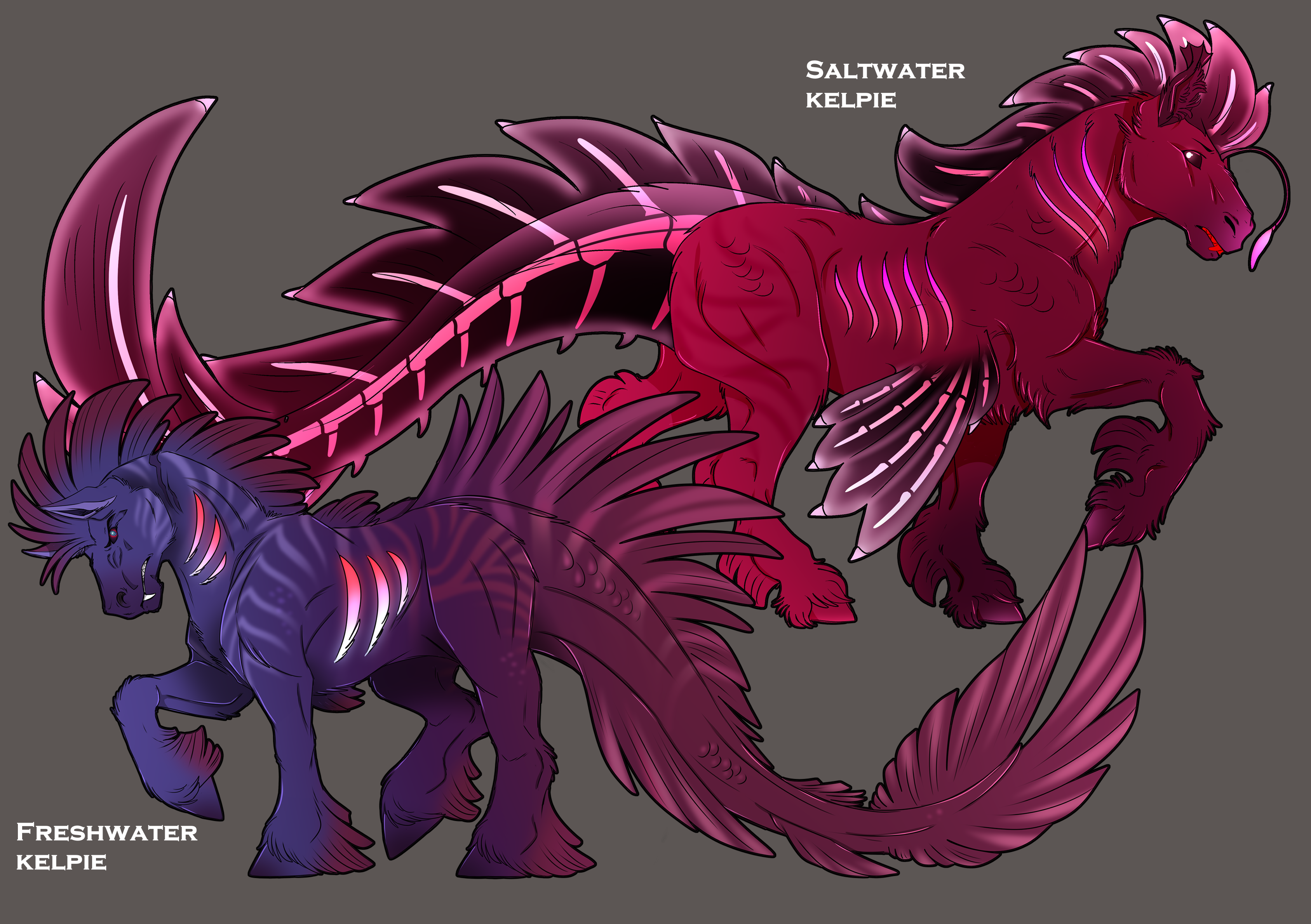
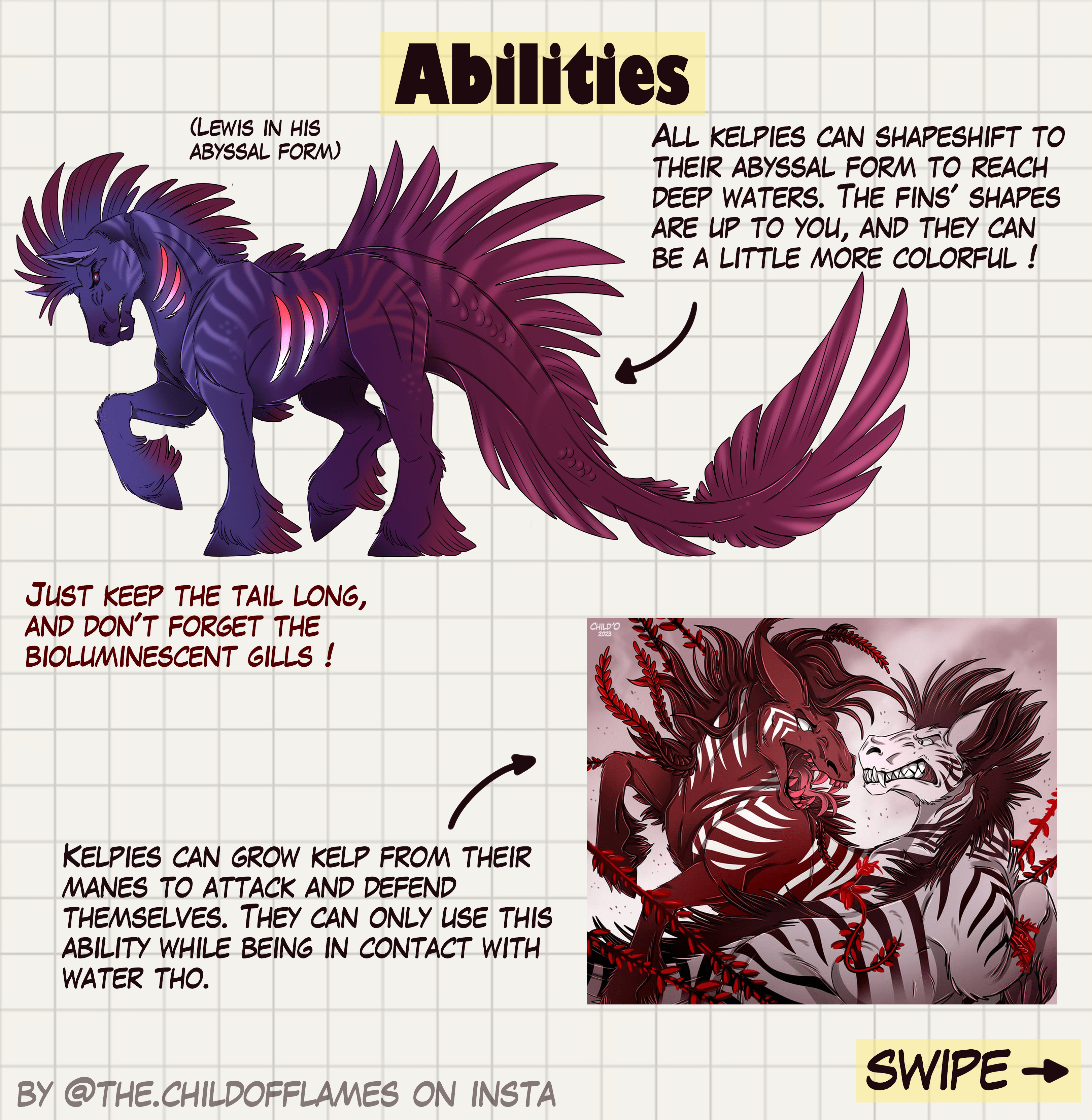
Abyssal forms, also called "true colors" or "the other form" by kelpies, are the alternative appearances taken by freshwater kelpies and saltwater kelpies. Other species know less about these due to not witnessing them often but are as essential and useful to the kelpies nonetheless.
a saltwater kelpie (top) and a freshwater kelpie (bottom) in abyssal forms. (click to zoom)
Abyssal forms completely change the colors of a kelpie - these colors are random, and have nothing to do with their species or gender.
They get longer fish-like tails and various new fins of diverse shapes. Their bodies are covered in a mix of fish-like scales and fur.
The eyes' sclera gets very dark, and the gills they earn are located on their neck, flanks, and sometimes tail.
Vasco (freshwater kelpie) showing his abyssal form.
The gills are bioluminescent
and the light intensity goes along with their respiration.
The main difference between freshwaters and saltwaters, apart from the size, is that saltwater have multiple see-through parts on their tail and fins, showing their bones inside. They also have a little lantern-like appendage on their forehead, similar to anglerfish, as well as little fins on their ears (a trait that can be observed on freshwaters too, but all saltwaters do have it).
Saltwaters also have a lot more bioluminescence on their bodies.
Kelpies can mostly be seen in their terrestrial forms, in which they are still able to swim very well. However, they can shift to their abyssal forms,
which are much more fish-like and designed for the water. It is mostly a question of comfort, as freshwater kelpies prefers to hunt in their terrestrial form,
enjoying their ability to quickly alternate between land and water to hunt, while saltwaters strictly hunt in the ocean.
Lewis and Kiersten dancing, both freshwater kelpies.
Fins and fish-tails improve the kelpie's mobility underwater and allow them to be faster. The bioluminescence of their gills and some markings are known to be
a way for kelpies to communicate with each other as some kind of body language.
Their underwater vision and smell are improved, and of course, their respiratory system is entirely dedicated to breathing underwater, therefore a
kelpie in their abyssal form can't breathe the surface's air. They also become more adapted to the various levels of pressure of the water environments.
The shapeshifting can be used at will by kelpies.
It takes some months for the foal to master it completely. Foals will discover the surface before the deep waters.
Saltwater kelpies are known to be able to dive deeper than freshwater kelpies, due to the fact they live in the ocean. They are also more prone
to use their abyssal form than freshwater kelpies.
a battlescarred freshwater kelpie.
Freshwater kelpies are not appreciated by most species of the Crater. Their "vicious" ambush-hunting tactics and the fact they can practically kill any creature
(even bigger than them) made them have a very bad reputation among the other creatures (pegasi, unicorns, woolies, blue wyverns...). At their time, unicorns were
the natural ennemy of freshwater kelpies, and the only creatures who could compete with them in a fight apart from big noctules.
The appellation "water demons" is a good illustration of how kelpies are perceived by these species. Waters are scary for most creatures because it is their
natural habitat. Kelpie foals are often the target of other species, as they see an occasion to get rid of a future predator. Many rumors, legends, and songs have
been created about kelpies, inspired by the fear of them. One of the most common myths is that their red stripes are made with their victims' blood, which is
obviously false.
But kelpies are not hated by everyone. Jaguoons, for example, share a particular relation with the freshwater kelpies, as the red kelp forests they create gives
the little felines a very good environment to hide and raise their youngs. The carrions left away by kelpies is also a very nice food resource for jaguoons.
Freshwater kelpies rarely encounter their cousin species as they usually don't go in the same environments for comfort purpose, but some rare freshwater kelpies are accepted in saltwaters'
herds and can adapt pretty well. It's common to see a saltwater kelpie with freshwater ancestry in a herd, with more or less traits showing.
Abilities and powers
_____________________________
Kelp vines : The ability to grow kelp vines and lianas from the mane ; mostly used for self-defense or hunting.
Natural strength : Kelpies are very strong creatures, they are known to kick hard, and their bite is very powerful, crushing bones and flesh under their strong jaws.
Abyssal form : check the abyssal form section for more details.
Trivia
_____________________________
▪ The kelpies from the Water Demons universe are heavily inspired by the original kelpie coming from Scottish and Irish cultures, though they have notable differences and unique elements to make them more unique.
▪ Originally named "zebra kelpies" due to their stripes, it was decided that the other characters would call them just "kelpies".
▪ The species can be tamed by humans ; but the foals have to be born in captivity to maximize their chances of being docile and obedient as they are highly dangerous creatures. Wild kelpies are completely untamable.
Creation guide (make your own freshwater kelpie !)